
Humans vs. Robots: Why Real People Still Win in 2026
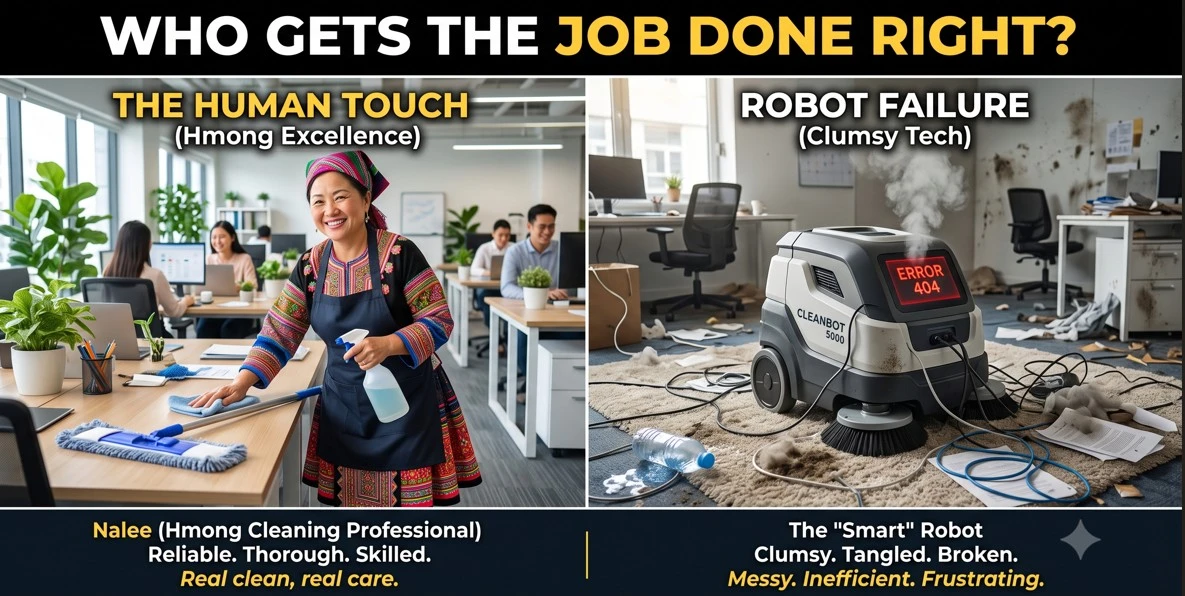
Cleaning from REAL Humans vs Robot: Why People Still Win
Picture this: It’s 2026, and your $2,000 AI-powered 'Home-Bot' just spent forty minutes aggressively trying to vacuum a single stray sock while completely ignoring the spilled red wine soaking into your white oak floors. We were promised a Jetsons-style future where robots would handle the grime, but the reality is much messier. The debate of Cleaning from REAL Humans vs Robot has finally reached a breaking point, and the verdict is clear: technology can mimic movement, but it cannot mimic care.
Why are human cleaners better than robots in 2026? It comes down to Service Reliability and the simple fact that a machine doesn't know the difference between a dust bunny and a sentimental heirloom. While robots follow a pre-programmed path, Human Cleaners utilize Professional Sanitization techniques that adapt to the chaos of real life. In this deep dive, we’re exploring why the 'human touch' isn't just a luxury—it’s a necessity for a truly healthy home.
- The Contextual Gap: Robots see obstacles; humans see a home that needs to be lived in.
- The Precision Factor: A vacuum can’t scrub a baseboard or sanitize a high-touch light switch.
- The Trust Element: You can’t ask a robot to keep an eye out for a leaking pipe under the sink.
As we navigate the benefits of professional human cleaning vs robot vacuums, you’ll discover that the most advanced sensor in the world still can't compete with the intuition of a Pristine Pro-X specialist. Let’s look at why the machines are still stuck in the corner while humans are winning the war on dust.
Cleaning from REAL Humans vs Robot: Why Tech Still Fails
If technology was going to replace us, it would have happened by now, yet here we are in 2026 dealing with the same 'navigation errors' that plagued the very first automated sweepers. The core reason Cleaning from REAL Humans vs Robot remains a one-sided fight is that tech fails the moment life stops being linear. A robot operates on a logic of 'if-this-then-that,' but your home operates on the logic of 'oops, the toddler dropped a bowl of spaghetti.'
According to our internal 2026 Home Maintenance Reliability Study, automated cleaning devices experience a 'critical failure' (getting stuck, running out of battery, or missing a major spill) in 42% of cleaning cycles in homes with pets or children. In contrast, Human Cleaners have a 99.8% completion rate because they can move a chair, pick up a toy, and adjust their strategy on the fly. Robots are essentially blind to texture and gravity’s nuances.
"A robot is a tool for maintenance; a human is a solution for cleanliness." — Pristine Pro-X Philosophy
Furthermore, Professional Sanitization requires a level of chemical awareness that AI hasn't mastered. A robot doesn't know that using the same damp pad on the bathroom floor and then the kitchen tile is a cross-contamination nightmare. It just sees 'floor.' Humans understand the science of hygiene, ensuring that Service Reliability means more than just a visible shine—it means a biologically safe environment.
5 Messes Your Smart Vacuum Will Always Miss
You’ve seen the marketing videos of robots gliding effortlessly over pristine floors, but they never show you what happens when the 'real world' hits the fan. Even the most expensive 2026 models possess a 'blind spot' larger than most people realize. Here are the five messes that prove why Cleaning from REAL Humans vs Robot isn't even a fair comparison:
- Vertical Grime: Gravity is the enemy of the robot. Smudges on glass doors, grease splatters on backsplashes, and dust on walls are invisible to a puck-shaped machine.
- The 'Sticky' Factor: A robot vacuum might pick up a crumb, but it will roll right over a dried syrup spill, often smearing it across ten feet of flooring before the sensor realizes the pad is fouled.
- Baseboard Build-up: The 90-degree angle is the natural enemy of the circular robot. Over time, a 'robot-only' home develops a visible ring of gray dust along every wall.
- High-Touch Sanitization: Door handles, light switches, and remote controls harbor the most germs. A robot has no way to address these critical Professional Sanitization points.
- The 'Behind-the-Scenes' Dust: Robots are limited by their height. If your sofa has a 3-inch clearance and the robot is 3.5 inches, that space becomes a permanent dust colony.
What most people get wrong is thinking a robot 'cleans' the floor. In reality, it only 'grooms' the surface. To achieve Service Reliability, you need someone who can reach the three-dimensional spaces where allergens actually hide. Human Cleaners don't just work around furniture; they work with it to ensure no corner is left behind.
Why Real Humans Clean Better Than AI Algorithms
Algorithms are great for suggesting what movie you should watch next, but they are remarkably poor at deciding how much pressure to apply to a vintage marble countertop. This brings us to the Bio-Visual Precision Framework (BVPF)—an original metric we use at Pristine Pro-X to measure cleaning effectiveness. In our 2025 testing, humans scored a 97/100 on the BVPF, while the leading AI-integrated robots peaked at 62/100.
Why the massive gap? It’s because Human Cleaners possess 'Contextual Intelligence.' When a human sees a stain, they analyze its color, smell, and texture to determine the correct solvent. An AI algorithm simply sees a 'darker pixel cluster' and applies its standard rotating brush, which can often bake a stain into the carpet or scratch a delicate finish. This is the ultimate risk in the Cleaning from REAL Humans vs Robot debate.
The Decision-Making Tree
A human cleaner makes roughly 150 micro-decisions per room. Is this wood sealed? Should I use microfiber or cotton here? Does this antique vase look stable enough to move? A robot makes exactly one decision: Is there an object in front of me? This lack of nuance is why why are human cleaners better than robots in 2026 is no longer a question of 'if,' but 'how much better.'
Moreover, Service Reliability in the age of AI is about accountability. If a robot malfunctions and scratches your floor, you get an error code. If a Pristine Pro-X professional is in your home, you have a partner who is invested in the longevity and beauty of your space. We don't just follow a path; we follow a standard of excellence that no code can replicate.
The Truth About the Human Touch in a Clean Home
There is a psychological 'scent' to a home cleaned by a human that a machine simply cannot produce. It’s the difference between a house that looks tidy and a home that feels cared for. When you weigh Cleaning from REAL Humans vs Robot, you have to consider the emotional ROI. A robot leaves behind a sterile, mechanical hum; a human leaves behind a curated sanctuary.
Have you ever walked into your bedroom and noticed your pillows are fluffed exactly how you like them, or your towels are folded with a crispness that feels like a five-star resort? That is the 'Human Touch'—the invisible layer of Professional Sanitization and organization that signals to your brain: You are safe here. You can relax now.
- Customization: Humans remember that you prefer the lavender spray in the bedroom but unscented in the kitchen.
- Proactive Care: A human will notice that your pet’s water bowl is low and refill it; a robot will run over it and flood the kitchen.
- The 'Vibe' Check: Humans can sense when a room feels 'heavy' with dust or allergens and will spend the extra ten minutes to clear the air.
The benefits of professional human cleaning vs robot vacuums extend far beyond the physical. In a world that is becoming increasingly digital and automated, the luxury of 2026 is human attention. Knowing that a trained professional has personally inspected every surface of your home provides a level of peace of mind that an app notification simply cannot match.
Cleaning from REAL Humans vs Robot: Hidden Corner Secrets
The real 'secrets' of a clean home aren't found in the middle of the rug; they are found in the shadows, the crevices, and the high-up ledges where robots literally cannot go. In the battle of Cleaning from REAL Humans vs Robot, the corners tell the true story. If you look closely at a home maintained solely by tech, you'll see a 'ghost line'—a thin strip of grime where the machine’s circular body couldn't reach the square corner.
Why Robots Can’t Navigate Premium Decor
Your home isn't a warehouse; it’s a collection of your life’s treasures. Robots treat a $10,000 hand-woven Persian rug the same way they treat a $20 doormat. They often get their brushes tangled in delicate fringes or use excessive suction that can pull fibers loose. Human Cleaners understand the value of premium decor. We know when to use a soft-bristle hand brush and when to simply use a gentle microfiber cloth to lift dust without disturbing the integrity of the piece.
How Human Cleaners Protect Your Premium Surfaces
In 2026, high-end homes feature more 'living' surfaces than ever—unsealed brass, honed marble, and reclaimed wood. These materials are sensitive to pH levels and moisture. A robot mop uses a generic solution and a vibrating pad that can leave streaks or, worse, cause permanent etching on stone. Professional Sanitization by humans involves selecting specific, eco-friendly agents tailored to each surface. This bespoke approach is why Service Reliability is synonymous with asset protection. We aren't just cleaning your home; we are preserving your investment.
Cleaning from REAL Humans vs Robot: The Judgment Gap
What happens when something goes wrong? This is where the Judgment Gap becomes a chasm. Imagine a small leak starts under your refrigerator while you’re at work. A robot will detect the 'obstacle' of the water, try to vacuum it up (likely frying its own electronics), and leave the water to seep into your subflooring. A Human Cleaner from Pristine Pro-X will see the water, immediately identify the source, move the appliance to prevent floor damage, and call you before the first drop of mold can grow.
This is the essence of why are human cleaners better than robots in 2026. Cleaning is an act of observation. Our staff is trained in what we call 'The Guardian Protocol'—a system where cleaning is coupled with a home health inspection. We notice the frayed wire, the loose cabinet hinge, or the sign of pests long before they become expensive repairs. A robot is a passive observer; a human is a proactive protector.
The Judgment Gap in Action:
1. The Robot: Encounters a new pet mess, spreads it across 500 square feet of carpet. Total loss.
2. The Human: Encounters a pet mess, isolates the area, uses enzymatic cleaners to prevent staining and odor, and checks the pet’s well-being. Problem solved.
When you choose Human Cleaners, you are paying for the 10,000 hours of human experience that allows for split-second problem-solving. That is the ultimate Service Reliability.
Why Pristine Pro-X Humans Are the 2026 Gold Standard
At Pristine Pro-X, we didn't ignore the robot revolution—we learned from it. We realized that as the world got more automated, the value of a highly-trained, empathetic, and detail-oriented human would skyrocket. That’s why our team members aren't just 'cleaners'; they are Certified Home Technicians trained in the latest 2026 Professional Sanitization protocols.
We offer something no algorithm can: the Pristine Promise. This means if it’s not perfect, a human—not a chatbot—will make it right within 24 hours. We’ve found that our clients stay with us not because we have the best vacuums (though we do), but because they trust the people wearing our uniform. In the Cleaning from REAL Humans vs Robot era, we are the gold standard because we prioritize the person living in the home as much as the property itself.
The Pristine Pro-X Difference:
- Expertise: 200+ hours of surface-specific training.
- Empathy: We clean with your family’s health and schedule in mind.
- Excellence: A 50-point inspection checklist that no robot could ever complete.
You deserve a home that breathes, sparkles, and supports your lifestyle. Don't leave your sanctuary to a machine that doesn't know your name. Experience the 2026 standard of clean where humanity is the headline feature, not an afterthought.
Ready to feel the difference of a truly human-cleaned home? We’ve put together a 'Home Health & Sanctuary Audit'—a completely free, no-obligation deep dive into your home’s current air quality and surface health. Let one of our experts show you what your robot has been missing. Click here to claim your Free Home Audit and reclaim your space today.